Can You Use AI (ChatGPT) on Your CASPA Personal Statement? 2025–26 Rules vs. 2026–27 Changes
Wondering if you can use ChatGPT or other AI tools on your CASPA personal statement? Here’s what CASPA rules say for the 2025–26 cycle, what changes in 2026–27, and a safe way to edit without risking a policy violation.
The short answer for pre-PA student applicants
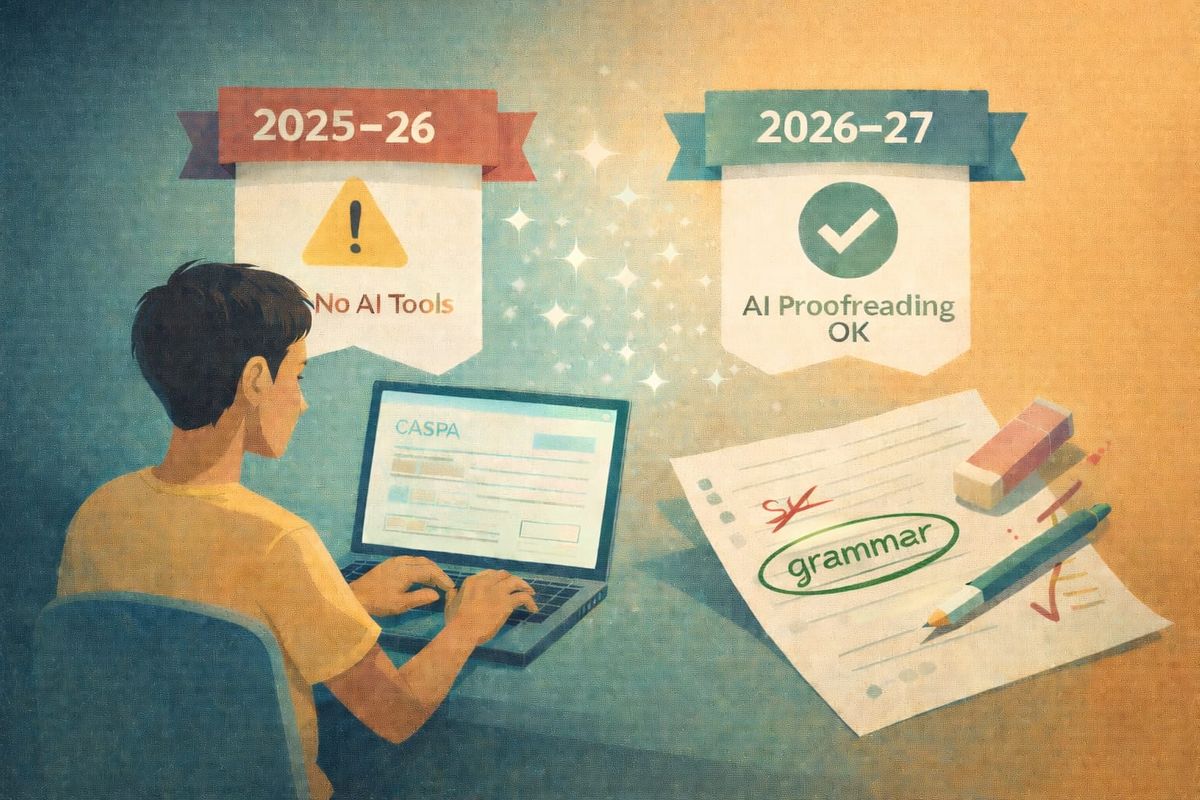
- Applying in 2025–26: CASPA’s applicant agreement says you cannot use generative AI to create, write, or modify content you submit in CASPA.
- Applying in 2026–27: CASPA policy language shifts: applicants may consult resources including AI tools for non-substantive edits (spelling/grammar), as long as the final submission is truly their own writing and experiences—and applicants must follow each program’s policy.
What CASPA says for the current cycle (2025–26): “No generative AI” (including editing)
In the 2025–26 CASPA applicant agreement, you attest that your written passages:
- are your own work, and
- have not been written or modified “by any other person” or any generative AI platform (example given: ChatGPT).
CASPA then states you are strictly prohibited from using generative AI to create, write, and/or modify any content submitted in CASPA.
Why students get tripped up here
A lot of applicants think the rule is “don’t have AI write your essay.” But the 2025–26 wording also covers AI-based rewriting or “polishing,” because that’s still “modify.”
What changes next cycle (2026–27): AI allowed for “non-substantive” edits
In the 2026–27 Policies & Procedures, CASPA includes guidance acknowledging that generative AI is widely integrated and can be used to proofread—while also posing risks.
The key policy shift is the certification language:
- You certify the writing is your own;
- Consulting “personal and professional resources,” including AI tools, for non-substantive changes like spelling/grammar is acceptable; and
- You must follow each program’s institutional policy on AI tools.
Practical meaning: CASPA is drawing a line between mechanical cleanup vs. substantive authorship.
“AI detection” reality: why enforcement is messy (and what that means for you)
CASPA/PAEA explicitly cautions that AI detection tools have high false-positive rates and can wrongly flag human writing.
And importantly: PAEA will not initiate a CASPA investigation if the only basis is an AI detector flag on a personal statement or evaluation.
This doesn’t mean “anything goes.” It means you should focus on:
- following the written policy for your cycle, and
- protecting yourself from avoidable risk (especially in 2025–26).
What’s “non-substantive” vs. “substantive”? (Use this as your mental checklist)
Non-substantive (generally “mechanical”)
- spelling, punctuation, grammar fixes
- obvious typos
- minor readability tweaks that do not change meaning
This is the category 2026–27 policy explicitly allows.
Substantive (high-risk)
- generating paragraphs or full drafts
- rewriting your voice/style
- adding new experiences, claims, or examples
- “make this more compelling” rewrites that change tone and content
That’s the kind of help CASPA is trying to prevent—especially in 2025–26.
Safe workflows (by cycle)
If you’re applying in 2025–26 (strictest)
Safest approach: do not use generative AI for drafting or editing your CASPA submissions.
Instead:
- write in your own words
- use a human proofreader for obvious typos
- keep drafts/version history
If you’re applying in 2026–27 (new guidance)
A “safe” approach aligned with the policy:
- Write your draft yourself
- Use AI only for spelling/grammar checks
- Keep your final submission authentic to your writing and experiences
- Check each program’s AI policy
FAQ
Can I use ChatGPT for my CASPA personal statement?
- 2025–26: prohibited to create/write/modify CASPA content using generative AI.
- 2026–27: AI may be consulted for non-substantive edits (spelling/grammar) if the final submission is your own work and you follow program policies.
What if an AI detector flags my essay?
PAEA warns detection tools can be inaccurate and states it will not initiate an investigation based solely on an AI detection flag.
Do PA programs have their own rules?
Yes. The 2026–27 policy explicitly puts responsibility on applicants to follow each program’s institutional policy on AI.